Added Nov 25, 2023 9:00am
“Seven single-word values (each with a short sentence of explication) are easier to remember and use as touchstones in our conversations, in congregational governance, and in educational settings.”
–2021-2023 Article II Study Report
The Charge to the Article II Study Commission used the words “inspirational,” “memorable,” “brief” and “poetic” to articulate objectives for an Article II bylaws revision.
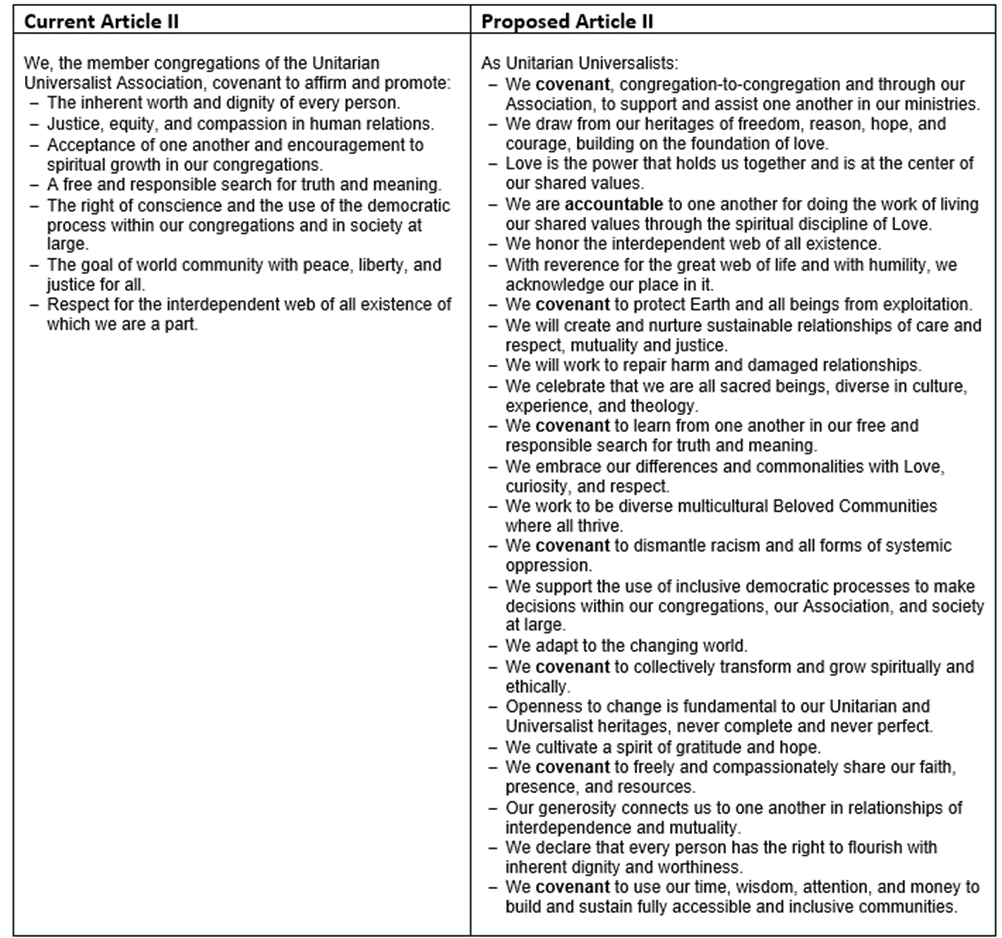
In fact, the Values and Covenant statements are three times longer than the current Principles, (311 v. 102 words), and certainly no easier to remember.
More troubling than length is their creedal nature. Despite reassurances that UUs do not have a creed, the Study Commission created a document that reads like one. In addition to the seven statements that begin “We covenant to…” it is replete with other statements that imply commitment, such as “We acknowledge…” “We work to…” and “We support…” Statements such as these do not inspire, as they can be coercive and subject to “community conscience,” rather than individual conscience.
Most troubling of all is the statement: “We are accountable to one another…” Accountability implies enforcement and consequences. Covenants in UU have been aspirational, not obligations. How this revised interpretation could play out in “Beloved Community” should concern all UUs.
When the Values and Covenants are written out as sentences, without the flower petal and value words, they feel uncomfortably akin to creeds, such as the Nicene Creed (217 words), that are recited in Christian churches.
Let us not forget that individual Freedom of Belief, commitment to spiritual growth, and a peaceful world community are hallmarks of Unitarian Universalism’s unique identity as a liberal faith. The Article II proposal is taking all that away.
If you haven’t yet done so, please sign up to help stop this assault on our liberal religion. Consider becoming a virtual delegate at General Assembly 2024. It’s free and you can vote from the comfort of your own home
 Where are the 7 Principles?